WhentheRoleBreaks
Social Role, Identity, and Mental Health in Street Corner Society.
“In the 1930s, a man named Doc started getting dizzy spells. His doctor found nothing wrong.”
Doc was Ernest Dean Pecci. A North End Italian American, born and raised on the same narrow streets he later ruled as the leader of the Nortons. He was a fighter as a kid and an artist as a man — a stained glass worker, a storyteller, the one everyone came to when a dispute needed settling. He was respected everywhere in the neighborhood.
Then the Depression reached him. The firm that had promised him a career folded. The paychecks stopped. The dizzy spells began. They came on only when Doc was around his friends, only when he was unable to act like the man he had always been.
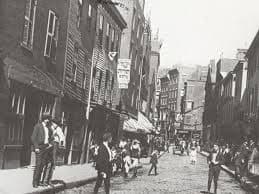
He was not an ordinary man.
Doc grew up on North Bennet Street, the sharp-eyed son of an Italian immigrant family. His mother dressed him in clean suits. Other mothers held him up as an example. But he was also, from early on, a fighter — feared and admired by the boys his age.
“I was a tiger when I was a kid. I wasn’t afraid of anybody.”
In his twenties he was making stained glass windows at twenty-five dollars a week. The boss liked him. Raises were promised every six months. He took pride in each piece — the cuts, the lines, the shapes of the light. Then the boss died and the firm folded and the Depression closed the door.
He read a hundred books on the English language. He could hold a corner’s attention for an hour with a single story. Teachers had kept him after school just to write things up for them. Everybody came to him — for money, for advice, for a decision. The nickname stuck: Dean. Doc. The authority on any question anyone might dispute.
“It wasn’t just the punch. I was the one who always thought of the things to do. I was the one with half a brain.”
What did Whyte believe was the real cause of Doc's dizzy spells?
He moved in. He watched. He wrote everything down.
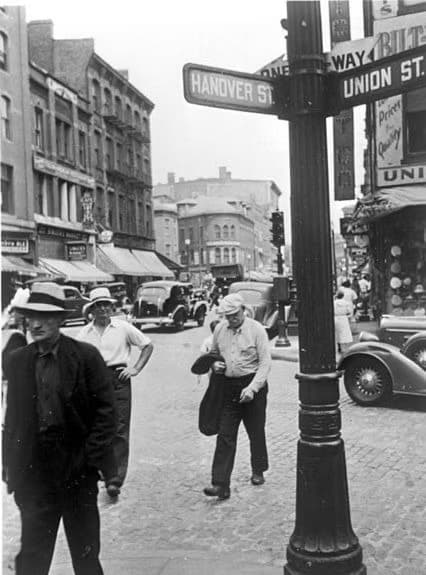
In 1936 William Foote Whyte arrived in the North End as a Harvard research fellow. He stayed almost four years. He studied street corner gangs, local politics, crime, social mobility, and the churches and clubs that held the neighborhood together. The outside world called Cornerville disorganized. Whyte came to argue the opposite: it was organized in its own way — a way that did not fit the structures of mainstream America.
The dizzy spells kept catching his attention. They never came when Doc was alone. They came around people — and only when Doc could not act like Doc. Whyte began to read them not as a symptom of illness but as a symptom of a role that could not be performed.
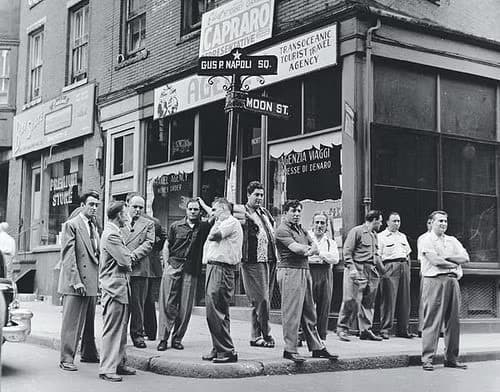
It wasn’t the poverty. It was the role.
Whyte’s claim is specific. Poverty was the trigger, but it was not the cause. The cause was the disruption of Doc’s social role — the role of leader. Doc was accustomed to paying for things, organizing the group, making the decisions. Money was not just money. Money was the medium through which that role became real.
Without it, Doc stopped showing up. And when he did show up he stayed quiet. He avoided his friends rather than face the humiliation of not being able to act like himself. A man whose whole life was originating action could no longer originate anything.
“When I’m batted out, I’m not on the corner so much. And when I am on the corner, I just stay there. I can’t do what I want to do. If the boys want to go to a show or to Jennings or bowling, I have to count my pennies to see if I have enough.”
“I have thought it all over, and I know I only have these spells when I’m batted out. I’m sorry you didn’t know me when I was really active around here. I was a different man then.”
According to Goffman, what is social life most like?
Social life as performance.
In 1959, Erving Goffman published The Presentation of Self in Everyday Life. His argument: social life is a continuous performance. We manage the impressions we project to others in order to hold together a stable identity. Goffman called this face. When the performance fails, the self that depends on it fails with it. The result is not just awkwardness. It is collapse.
The map onto Doc is direct. Doc’s role was leader. Without money he could not perform the role — could not treat, could not host, could not decide. The self he had built over decades had no stage to stand on. It fell.

Before the book, the page.
Whyte’s unpublished field notes from April 1937 catch Doc in his own voice — before anyone has called him a sociological subject. A proud man. A funny man. A fiercely intelligent man whose identity was welded to being competent and respected.
- 01
“When I was a little boy, I used to dress very neatly. I always used to have a clean suit on, and when I sat down on the doorstep my mother told me always to sit on a newspaper. Other mothers would tell their sons, Look at the way Nesti dresses. Why can't you be like Nesti?”
- 02
“I was a tiger when I was a kid. I wasn't afraid of anybody.”
- 03
“It wasn't just the punch. I was the one who always thought of the things to do. I was the one with half a brain.”
- 04
“I had a job making stained glass windows. I was making $25 a week, and the boss liked me. He said he would raise me every six months until I was making $50 a week. So I had no worries. But then the boss died, the depression came, and the firm folded up.”
- 05
“Before, when I was working, I would take a lot of care with my drawings. I would study up to see just how they should be. I took some pride in my work. But now it's just a job. I sit down and slap it out.”
- 06
“You know, maybe I could be a writer. When I was in school, the teacher used to keep me after sometimes to write things up for her. I used to be a great story teller around here. They used to be after me for stories all the time.”
What happened to Doc after Street Corner Society was published?
Then the book came out.
Street Corner Society was published in 1943. It became a landmark in American sociology. But the man at the center of it was alive, and living in the same neighborhood, and eventually recognizable. Doc had given talks at Harvard and at Wellesley about the book — which Whyte’s lawyers would later argue meant he had waived confidentiality. His real identity became public.
“That book has ruined my father’s life.”
Doc’s sons, Robert and Ernest, later said the book ruined their father’s life. He became paranoid. He withdrew from the neighborhood. He stopped seeing his closest friends. He avoided the streets that had been his whole world. Doc died in 1967.
In 1992 his sons hired a lawyer and sent a letter to Whyte at Cornell University, threatening to sue for defamation and breach of contract. Without Doc, they argued, Whyte could not have written the book. Whyte had promised not to reveal Doc’s identity. By doing so he had made both sons subjects of abuse and ridicule. Whyte’s lawyers responded that the statute of limitations had long passed, that there was no written agreement, and that Doc had voluntarily participated in public talks.
That same year, the sociologist Marianne Boelen returned to Cornerville. She interviewed surviving community members, including Pecci’s sons, and published her findings in the Journal of Contemporary Ethnography. She found the community did not recognize itself in the book. Key scenes, including the bowling passages, were disputed by people who had been there.
The uncomfortable conclusion writes itself. The same mechanism that caused Doc’s breakdown during unemployment seems to have operated again after publication. The researcher who had studied social harm may have caused it.
What did the 2024 global study on unemployment find?
One man in 1930s Boston. The whole world, now.
In December 2024, Yang, Niu, Amin, and Yasin published a study in Frontiers in Public Health examining the relationship between unemployment and mental health across 201 countries from 1970 to 2020. Using a fixed-effects model on half a century of global data, they found a strong and consistent positive association between unemployment and anxiety disorders, depression, and bipolar disorder.
What Whyte saw in one man in one neighborhood holds up at global scale, across a century of completely different populations. The mechanism is not period, not place, not Italian American masculinity in the Depression. The mechanism is human.
Relative indicators for display purposes. Source: Yang, Niu, Amin, and Yasin, Frontiers in Public Health, 2024.

This is not a story about one man.
Doc’s story happened in one neighborhood almost ninety years ago. But the pattern is not specific to that time or place. When the structures that give people’s lives meaning are taken away, the damage is real and measurable.
This happens to people today. It happens across languages and continents and decades. The role breaks. The self follows. The project asks the audience to sit with that.
What is the broader argument of this project?
Annotated bibliography.
Five sources. A set of field notes, a slide presentation, a critique published fifty years after the book, a foundational work of twentieth-century sociology, and a 2024 global study.
- 01
Whyte, William Foote. "Pecci's Life." Field notes, April 24–27, 1937. Reproduced in course materials, WR152, Boston University, Spring 2026.
These field notes show Ernest Dean Pecci speaking in his own voice about his childhood, his fights, his work as an artist, and his struggle to find stable employment during the Depression. Unlike the published book, the notes show Doc before Whyte shaped him into a sociological subject. He comes across as proud, funny, and someone whose whole identity was tied to being competent and respected. This is the most direct evidence source for the project. It lets me see the person behind the argument and compare what Doc actually said to how Whyte chose to represent him.
- 02
Pasto, James S. "Doc: Ernest Dean Pecci." Slide presentation, WR152, Boston University, Spring 2026.
This presentation brings together photos, census records, newspaper clippings, and legal documents related to the real Ernest Pecci. It includes his 1957 appearance on The $64,000 Question, a letter he wrote to the Boston Globe defending the North End, his obituary, and a 1992 letter from his sons threatening to sue Whyte. It also includes excerpts from Boelen's sociological critique. Together these materials show that Doc was a publicly engaged and intelligent person who felt the book had misrepresented him. They are essential for understanding his life beyond what Whyte described.
- 03
Boelen, W.A. Marianne. "Street Corner Society: Cornerville Revisited." Journal of Contemporary Ethnography 21, no. 1 (April 1992): 11–51.
Boelen returned to Cornerville decades after Whyte's fieldwork and interviewed surviving community members including Pecci's sons. She found that the community did not recognize itself in the book and that key scenes including the bowling passages were disputed. Most relevant to this project is what happened to Doc after publication. His sons said the book ruined his life. He became paranoid, withdrew from friends, and avoided the neighborhood entirely. Whyte argued that disrupted social roles cause psychological harm. Boelen shows that the publication of the book may have caused exactly that kind of harm to its main subject.
- 04
Goffman, Erving. The Presentation of Self in Everyday Life. New York: Anchor Books, 1959.
Goffman argues that social life is a kind of performance. People constantly manage the impressions they make on others to maintain a stable sense of identity. When someone loses the ability to perform their usual role, the result can be a real psychological crisis. This maps directly onto Doc's situation. When he lost his job he could no longer treat friends, organize outings, or lead his group. He lost the role he had always played and his body and mind broke down as a result. Goffman gives the project a theoretical language for explaining why Whyte's observation about the dizzy spells is not just an interesting story but a broader claim about identity and social life.
- 05
Yang, Yang, Lisi Niu, Saqib Amin, and Iftikhar Yasin. "Unemployment and Mental Health: A Global Study of Unemployment's Influence on Diverse Mental Disorders." Frontiers in Public Health 12 (December 13, 2024): article 1440403. https://doi.org/10.3389/fpubh.2024.1440403.
This study looks at the relationship between unemployment and mental health across 201 countries from 1970 to 2020. The authors find a strong connection between unemployment and anxiety, depression, and bipolar disorder. It shows that what Whyte observed in one man in 1930s Boston holds up at a global scale nearly a century later. The study operates very differently from Whyte's ethnography but confirms the same basic idea. Unemployment does not just hurt people financially. It damages mental health in ways that are measurable and consistent across very different populations.